Editor's Choice
Freud 99-762 Rail & Stile Bit

- Adjustable rail-and-stile for 5/8"–1-1/4" door stock
- 1/2" shank TiCo Hi-Density carbide
- Precision shims tune groove 7/32"–3/8"
Expert Review & Guide
Building cabinet doors in your shop means matching rail-and-stile profiles, groove widths, and shank stiffness to your router table—not grabbing the first three-bit kit that mentions kitchen. This guide compares ten cabinet door router bit sets in supplied order, from budget 1/4-inch shank bundles to Freud's adjustable Premier line, so you can see which cutters fit shaker frames, ogee profiles, and raised panels before you mount anything.
Start with our Top 3 picks for serious door work, scan the comparison table for shank size and bit count, then read every review for honest notes on table-only requirements, shim adjustment, and where import sets save money versus where Freud and YONICO earn their reputations on hardwood rails.

As an Amazon Associate we earn from qualifying purchases. We may earn a commission at no additional cost to you.
All ten cabinet bit sets appear below in supplied order. Compare shank diameter, profile style, and bit count before reading detailed reviews. No prices shown—confirm availability on Amazon.

If you are cutting your first cabinet doors on a budget router table, this three-piece 1/4-inch shank set is a practical entry into rail-and-stile work. The raised-panel profiles, tenon cutter diameter around 1-5/8 inches, and YG11 carbide inserts give you enough capability for MDF kitchen doors and shop projects without Freud-level spending upfront.
Expect table-mounted routing only—these are not palm-router bits. The anti-kickback body and hardened steel plates help on plywood and particleboard, but the 1/4-inch shank will flex if you push long oak rails too aggressively. Treat it as a learning set with shallow passes and sharp feeds on paint-grade stock.
Mount these bits only in a router table with a solid fence and hold-downs. Run test cuts in scrap MDF matching door thickness before touching hardwood. Speed should stay conservative on the panel bit—large diameters need lower RPM on most routers.
Label each bit after unpacking; import sets rarely print profiles clearly on the shanks. A simple rack saves hours when you switch between rail and stile mid-project.
When doors come out loose or tight, adjust pass depth in tiny steps rather than forcing feed rate. Most beginner frustration with budget sets is dull cutters and rushed feeds, not impossible geometry.
Upgrade path: once you outgrow 1/4-inch shank flex, move to Freud adjustable bits or YONICO 1/2-inch sets rather than rebuying another import trio.
Cut stiles full length first, then rails between shoulders. Use the same reference face against the fence every pass.
Dry-fit five joints before glue-up; budget sets punish inconsistent depth settings quickly.
If rails longer than 24 inches chatter or joints loosen after glue-up, move to 1/2-inch shank Freud or YONICO sets in this guide.
We may earn a commission at no additional cost to you.

Stepping up to 1/2-inch shank cabinet door bits changes how stiff the cut feels on hardwood rails. Exqutoo's three-piece raised-panel set mirrors the budget 1/4-inch kits in scope but adds the shank diameter serious table work prefers, making it a strong pick when you want a full door profile bundle without Freud pricing.
The cemented carbide cutters and anti-kickback design suit MDF, plywood, and solid wood within normal DIY door thicknesses. You still need accurate fence setup and multiple passes, yet the larger shank reduces the chatter that plagues thin-shank imports on thirty-inch stiles in maple or birch.
The 1/2-inch shank is the real upgrade story—use it with a variable-speed router table motor and sharp carbide. Clean the collet every swap so the shank seats fully.
Raised-panel profiles demand multiple shallow passes, especially in maple or birch. Finish the panel center before assembling frames so tear-out on the show face is easier to manage.
Compare directly to the 1/4-inch version in this guide: if your router accepts only 1/4-inch collets, this set is not compatible without an adapter you should not rely on for door work.
Store bits in the original foam if provided; loose drawers nick carbide edges faster than you expect.
Confirm your router accepts 1/2-inch collets natively. Adapters exist but add runout—avoid them on door work.
Use a split fence or window cutout to visualize the profile on test stock.
This set includes a raised-panel cutter; take multiple passes and keep the panel flat with cauls during glue-up.
We may earn a commission at no additional cost to you.

This 1/4-inch shank variant differs mainly in tenon cutter diameter—1-3/4 inches versus the 1-5/8-inch sibling—giving slightly more profile width for wider stiles and taller rails. If your cabinet doors skew larger than standard kitchen sizes, that extra diameter can matter on the router table.
Material compatibility matches the other import sets: MDF, particleboard, plywood, and hardwood with sane feeds. The same caveats apply—table use, anti-kickback helps, but 1/4-inch shanks are not the choice for daily production oak doors or long unbroken rails without mid-span support.
The wider tenon cutter suits doors with taller rails or wider stiles where the 1-5/8-inch sibling feels undersized. Verify against your door drawing before buying.
Anti-kickback design helps when learners feed inconsistently, but it does not replace push blocks and guard setup on the table.
For paint-grade MDF kitchens, this set can finish dozens of doors if you keep cutters sharp and avoid nails in reclaimed lumber.
If you already own the 1-5/8-inch set, skip this unless your designs truly need the larger cutter diameter.
Compare the 1-3/4-inch cutter against your stile width drawing. Wider cutters need more router power at safe RPM.
Stick with the 1-5/8-inch sibling if doors are standard 2-1/4-inch rails.
Lower RPM for large cut width; raise only when chips stay intact.
Test in scrap matching your project species before production runs.
We may earn a commission at no additional cost to you.
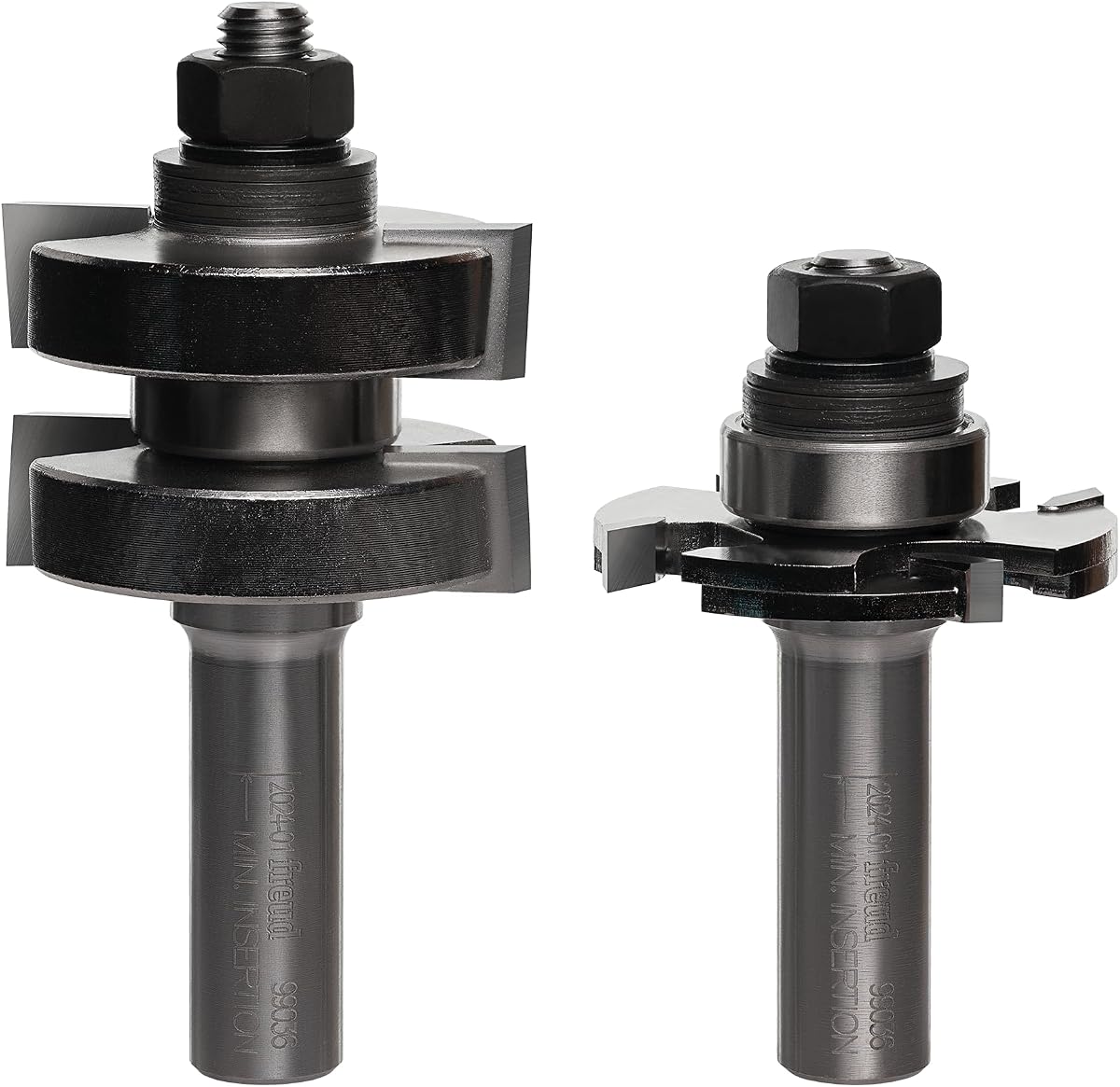
Freud's 99-036 adjustable tongue-and-groove set is the precision toolmaker's answer to fixed import profiles. With .002-inch adjustment increments, stock thickness from 1/2 to 1-1/4 inches, and groove widths from 7/32 to 3/8 inch, one coordinated pair handles thin plywood panels and thick solid-wood doors alike on the router table.
Silver I.C.E. coating and opposing shear angles attack the tear-out that ruins veneered rails. At 4.7 stars, it is the highest-rated specialist bit in this cabinet roundup—and rightly so for woodworkers who would rather shim once than buy new profiles every time panel thickness changes between jobs.
Adjustment is the skill: record shim combinations for 1/2-inch plywood cores versus 3/4-inch solid stock on a shop card taped inside the case lid.
Opposing shear angles show their worth on veneered plywood where blow-out on the bottom face ruins a whole door blank.
Pair with a good panel-raising strategy—either a separate panel bit or flat plywood panels depending on your design.
This is not a three-piece everything kit; it solves tongue-and-groove frame joints brilliantly, but you still plan panel treatment separately.
Start at minimum groove width and widen in small steps until the panel slides in with light hand pressure.
Record shim stacks on tape inside the case for each material thickness you use regularly.
Veneered plywood and solid hardwood both behave well when feeds are steady. Avoid rushing MDF cores on the first pass.
We may earn a commission at no additional cost to you.
Freud’s premier adjustable 99-762 rail-and-stile bit belongs near the top of any best router bits for cabinets shortlist for remodel shops. Shim-tuned grooves and long-tenon geometry reward careful table setups when stain-grade kitchen doors must close clean for years of seasonal movement.
TiCo Hi-Density carbide and a 4.7 rating reflect years of shop trust on veneered plywood, hardwood, and softwood doors. Table-mounted routing is where this bit shines—stable, adjustable, and built for the grain reversal you hit when a stile meets a rail on kitchen casework and vanity doors.
Dial groove width with Freud's shims until the panel floats correctly—too tight and seasonal movement cracks paint; too loose and rattles annoy homeowners.
Use a backer board on the outfeed side for long rails. Even premium carbide cannot fix a flexing workpiece climbing into the bit.
Clean Perma-SHIELD bits with appropriate solvents—never toss them loose in a drawer with metal tools.
If you build one kitchen a year, this bit still pays off versus disposable import sets that lose edge after a few hard maple doors.
One cutter means one setup for both joint faces—less fence drift between bit changes.
Still verify cut height with test sticks if you batch doors.
Flat panels, separate raising bits, or applied molding all work; pick based on door style and router horsepower.
We may earn a commission at no additional cost to you.
YONICO's 12343 three-bit round-over set delivers rail, stile, and panel cutters in 1/2-inch shank form—a complete round-over cabinet door profile at a mid-tier price. C3 micro-grain carbide and silver induction brazing give hobby shops a credible alternative to piecing together single bits from different brands on the same kitchen batch.
Rated 4.5, it is the strongest value complete door set here if you want round-over profiles rather than shaker or ogee. Table-mount use is required, and you should still dial RPM and feed for your species, but the trio covers frame and panel without hunting a fourth specialty cutter elsewhere.
Round-over profiles soften modern and transitional kitchens alike. The panel bit in this set needs careful speed control—start around the lower third of your router's range.
Induction brazing on YONICO bits generally holds up well for hobby volume. Inspect carbide after any crash into a hold-down.
Round-over rails show every fence misalignment; spend time squaring the table before production runs.
Compare to the shaker two-bit set in this guide if your taste runs minimal rather than molded.
Round-over rails soften edges on painted and stained doors alike. Keep profiles consistent on wall cabinets and bases.
Use the same bit set for matching drawer fronts when profiles align.
Lower RPM for large cut width; raise only when chips stay intact.
Test in scrap matching your project species before production runs.
We may earn a commission at no additional cost to you.

TAIWAIN's four-piece 1/4-inch shank set stretches beyond basic rail-and-stile into door, drawer, crown, and miter frame profiles—useful when cabinet work also means decorative molding on the same job. YG6 steel bodies and C3 carbide tips keep the bundle affordable for multi-profile hobbyists building their first kitchen plus trim package.
At 4.3 stars it trails Freud and YONICO, and the 1/4-inch shank limits heavy hardwood passes. Treat it as a versatile starter for mixed trim and door work rather than a production door system for daily hardwood casework in a professional shop environment.
The crown and miter bits extend this bundle beyond doors into room trim—helpful on install packages where cabinets and crown share a truck.
Drawer-front edging bits can dress slab drawers to match framed doors when you plan profiles carefully.
Lower rating suggests checking recent reviews for your specific router RPM range before purchase.
Not our top pick for dedicated door production—choose Freud or YONICO door sets if doors are eighty percent of your work.
Plan jobs that use crown and door profiles in one setup day to amortize bit changes.
Keep a printed profile chart near the table so helpers mount the right cutter.
Lower RPM for large cut width; raise only when chips stay intact.
Test in scrap matching your project species before production runs.
We may earn a commission at no additional cost to you.

Shaker doors dominate many kitchens, and YONICO’s two-bit 1/2" shaker rail-and-stile pair is a focused answer for best router bits for cabinets buyers. It delivers clean flat frames without ogee drama, mismatched multipack geometry, or guessing which cutters actually belong together.
You get rail-and-stile cutters only; raised panels are cut separately or purchased pre-made. For shops committed to shaker aesthetics and paint-grade flat panels, this focused pair beats buying a three-piece set with a panel bit that stays in the drawer after the first project ends.
Shaker doors sell because the profile is timeless and forgiving of paint. Cut rails and stiles with consistent depth stops; even a few thousandths variation shows at glue-up.
Without a panel bit, use flat plywood panels or raise panels on a separate setup—many shops prefer flat panels for paint-grade work anyway.
The wooden box is shop-worthy storage; label bit orientation with a marker on the shank heel.
Best pairing: this two-bit set plus a separate panel strategy equals a complete shaker door system at moderate cost.
Cut 3/8-inch-deep profiles in two passes if the first pass loads the motor heavily.
Flat panels simplify paint-grade kitchens and pair naturally with this two-bit set.
Return bits to the wooden box slots after cleaning to protect carbide from bench clutter.
We may earn a commission at no additional cost to you.

REKCKUL's ogee three-piece set targets traditional kitchen doors with decorative profiles, anti-kickback bodies, and tungsten carbide tips on 1/4-inch shanks. At 4.6 stars it leads the import ogee category here, with three-eighths-inch cutting depth and stock capacity around one inch for framed cabinet doors with molded edges.
The ogee look sells classic cabinetry, but remember the shank size: fine for MDF and paint-grade doors, less ideal for daily hard maple production. Pair shallow passes with a stout router table fence and featherboards on narrow rails for the cleanest results on stained hardwood doors.
Ogee profiles dress traditional kitchens where molded edges catch light on stained hardwood. Test stain on scrap cut with the same bit before running cherry or walnut doors.
Anti-kickback bodies help on ogee's varying contact angle—still use featherboards on narrow rails.
1/4-inch shank means keep rails shorter or support mid-span when possible.
If building stained high-end doors weekly, budget for Freud Premier instead.
Ogee shows scorch marks quickly—lower RPM on hardwoods and keep bits sharp.
Featherboards on the fence help narrow rails stay against the profile throughout the cut.
Lower RPM for large cut width; raise only when chips stay intact.
Test in scrap matching your project species before production runs.
We may earn a commission at no additional cost to you.
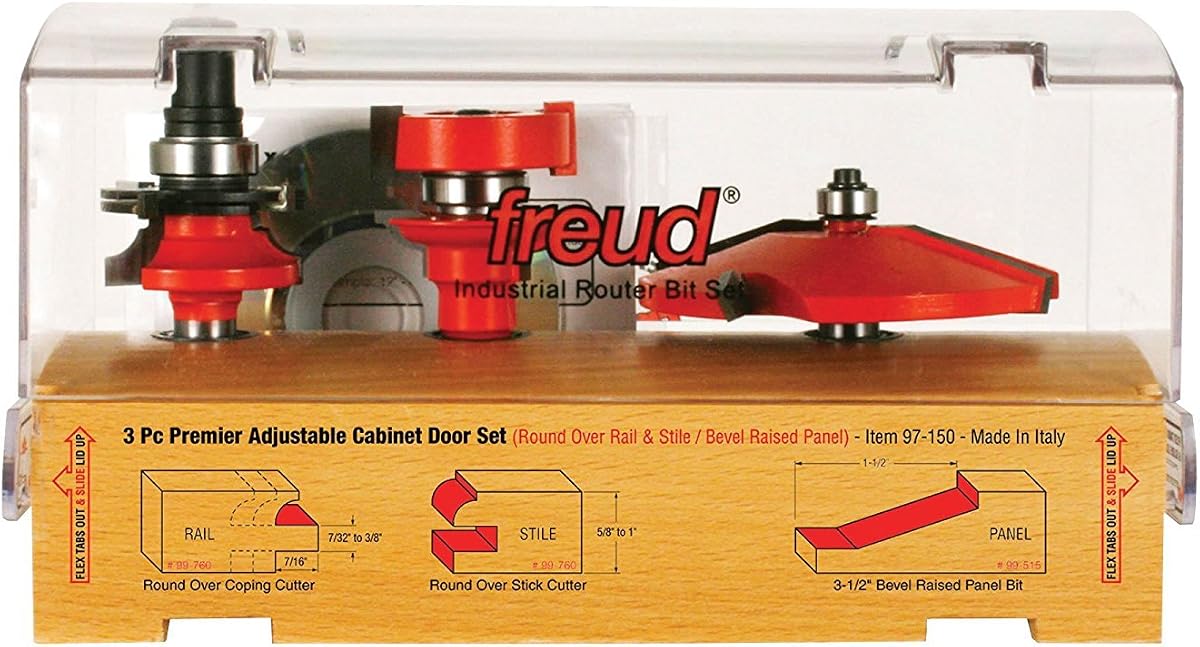
Freud's 97-150 Premier three-piece set is the upgrade path when budget import kits have taught you what you need—and you are ready for Quadra-Cut technology, adjustable rail-and-stile design, and a coordinated panel bit in one wooden case. Perma-SHIELD coating and 1/2-inch shanks signal serious casework, not weekend craft experiments.
The 4.2 rating reflects price sensitivity more than performance; experienced door makers consider this set a benchmark. If you build cabinets regularly, the combined adjustability and panel cutter justify the investment over rebuying worn import profiles every year when edge quality falls off on hardwood rails.
The Premier set bundles adjustable rail/stile technology with panel cutting in Freud's ecosystem. Treat setup day as a calibration session—do not rush the first door.
Quadra-Cut shearing action shows on end-grain at rail ends where blow-out often starts. Score lightly if needed.
Wooden case is worth keeping; bits this price deserve labeled slots.
Choose this when cabinet doors are core revenue or serious hobby output—not for a single vanity project unless you want top-tier tooling anyway.
Budget an afternoon to dial rail/stile and panel bits together on scrap door-sized pieces.
Premier sets reward patience with years of repeatable casework joints.
If you outgrow this set, individual Freud replacements are available—another reason pros start here.
We may earn a commission at no additional cost to you.

Cabinet door bits must match your router table, door thickness, profile taste, and how often you batch kitchen work. Use these factors before you buy a three-piece import set, a two-bit shaker pair, or Freud's adjustable Premier line.
1/4-inch shank bits fit compact routers and light tables but flex on long hardwood rails. 1/2-inch shanks are the standard for serious door work—they run truer in full-size router motors and reduce chatter on 30-inch stiles.
Match shank to collet capability first. Do not rely on collet adapters for production door cutting.
Two-bit shaker sets cut rails and stiles only—you supply flat or separately raised panels. Three-piece sets add a panel-raising cutter for traditional framed doors in one box.
Buy three-piece when you want raised panels on the same table setup. Buy two-bit when shaker flat panels define your style.
Budget sets use fixed profiles tuned for approximate stock thickness. Freud adjustable rail/stile and T&G bits use shims to tune groove width and cope with varying plywood cores.
Adjustable bits cost more upfront but survive changing door designs without buying new cutters.
Shaker profiles are flat and forgiving under paint. Round-over sets soften edges for transitional kitchens. Ogee bits deliver traditional molded detail that shows on stained hardwood.
Pick the profile your clients or household taste actually wants—bits are not easily swapped mid-kitchen without visual mismatch.
Every set in this guide expects router-table use for safe, repeatable joints. Handheld routing of rail-and-stile profiles is possible for experts but risky for beginners.
Invest in featherboards, hold-downs, and a split fence before spending on premium bits.
Freud TiCo carbide and Silver I.C.E. coating target heat and pitch on long runs. Import YG11 and C3 carbide work for hobby volume with sharp feeds and cleaning between sessions.
Dull carbide burns hardwood and loosens joints—plan resharpening or replacement schedules for batch work.
Start with YONICO or import 1/2-inch three-piece sets if you build one kitchen. Move to Freud 99-762 or 97-150 when doors become regular shop output.
Avoid buying both a budget trio and a Premier set simultaneously unless you have two tables—learn on one platform first.
Install rail-and-stile bits in a router table with the fence aligned to the bearing or pilot following the manufacturer's diagram. Set bit height using scrap the same thickness as your stiles, then lock the fence and depth stop before any production cut.
Cut stiles vertically and rails horizontally but stay consistent so copes and tenons mate cleanly. Use push blocks and featherboards—profile bits grab grain aggressively on narrow rails.
For raised panels, lower RPM versus rail cuts, take multiple shallow passes, and keep the panel flat with cauls during glue-up. Panels should float in the groove with room for seasonal movement unless you engineer plywood stability into the design.
Dry-assemble five doors and check square, reveal, and hinge alignment before glue. Router bits amplify small depth errors into visible gaps at stile shoulders.
Clean bits after every session—pitch buildup changes effective profile depth and heats carbide. Store cutters in labeled cases so rail and stile bits do not get swapped mid-batch.
When joints are too tight or loose, adjust bit height in tiny increments or shim adjustable Freud cutters rather than forcing feed speed. Sharp carbide and patient passes beat horsepower every time on cabinet doors.
At minimum you need rail-and-stile cutters for the frame. Raised-panel bits are required if you mill contoured panels on the table. Shaker flat-panel doors can use a two-bit rail/stile set only.
You can for occasional doors and paint-grade MDF, but 1/2-inch shanks are strongly preferred for long hardwood rails. Flex and chatter show up as loose joints and torn grain.
For repeated door work and adjustable groove control, yes. Freud 99-762 and the 97-150 Premier set reduce rebuying fixed import profiles when panel thickness changes.
Listing copy may suggest versatility, but rail-and-stile work belongs on a router table with fence support for safe, repeatable joints. Handheld use is expert-level only.
Shaker profiles are flat and minimal; ogee bits cut decorative S-curves on rails and stiles. Pick one style per kitchen for visual consistency.
Use the included shims in small steps, test with your actual panel stock, and record successful combinations. Adjustable bits tune from roughly 7/32 to 3/8 inch groove widths depending on model.
Usually bit height is too deep, groove width too narrow, or moisture swelled the panel. Sneak up on depth with scrap and verify panel thickness with calipers.
YONICO 12343 or Exqutoo 1/2-inch three-piece sets balance cost and stiffness. Upgrade to Freud 99-762 when you batch doors regularly or work mostly in hardwood.
Cabinet door routing rewards the right shank size and profile choice more than the biggest box of bits. Freud 99-762 is our Editor's Choice for adjustable rail-and-stile work, the 97-150 Premier set is the full-system upgrade, and YONICO 12343 covers round-over doors at strong value.
Budget 1/4-inch import sets teach the workflow on MDF and paint-grade work, but plan a 1/2-inch shank upgrade when stiles lengthen or species toughen. Every set in this guide assumes router-table discipline—fence, featherboards, and shallow passes.
Use the comparison table to match shank and profile to your router, read the reviews for honest limits, and confirm bit specs on the live Amazon listing before you mount the first rail.