Editor's Choice
Whiteside RU2100 Upcut

- Solid carbide 1/4" upcut spiral
- 1" cut length, 2-1/2" overall
- Top-rated for dados and grooves
Expert Review & Guide
Spiral router bits behave nothing like straight flutes—they pull chips up, push them down, or compress both faces depending on helix direction. Whether you are plowing dados in plywood, inlaying on a CNC, or flush-trimming laminate, the best spiral router bit for the job matches cut direction to the face you need clean. This roundup keeps all ten listings in supplied order.
Our Top 3 highlights proven performers for general upcut work, laminated sheet compression cuts, and template flush-trimming. Read the comparison table for cut length and coating, then dive into reviews that explain when downcut spirals save veneer tops and why coating matters on MDF-heavy days.


As an Amazon Associate we earn from qualifying purchases. We may earn a commission at no additional cost to you.
Ten spiral bits in supplied order—compare cut direction, cut length, and coating before reading full reviews. No prices shown; verify specs on Amazon.
Whiteside's RU2100 is the spiral router bit other brands get compared against—a solid-carbide 1/4-inch upcut with one-inch cut length and a 4.8 rating earned in real shops cutting dados, grooves, and plunge pockets. If you want one upcut spiral that handles hardwood, plywood, and MDF without drama, start here.
The upcut helix pulls chips toward the router motor, keeping the slot bottom clean while the far-side wall shears smoothly. That makes RU2100 the default recommendation for handheld mortises, table-routed grooves, and CNC slotting where chip clearance matters more than preserving a pristine top veneer face.
Run RU2100 at appropriate RPM for your material—large-depth slots in hardwood want slower speeds and multiple passes. Whiteside grinds hold up to resharpening on many models; treat this as a long-term shop bit.
Vacuum chips during deep upcut passes so flutes do not repack and burn. The upcut path sends chips upward—hood or shoe collection helps visibility.
Compare to downcut in this guide when your priority is top-surface quality instead of slot-bottom cleanliness.
Keep a dedicated collet wrench routine; solid carbide still snaps if the shank slips mid-cut.
Upcut clears chips and cleans slot bottoms; downcut protects top surfaces. Pick based on which face is show-critical.
Compression combines both for sheet goods with two visible faces.
Lower RPM for large cut width; raise only when chips stay intact.
Test in scrap matching your project species before production runs.
We may earn a commission at no additional cost to you.

SpeTool's downcut spiral flips the chip path—pushing waste downward so the top surface of your workpiece stays cleaner on dados, mortises, and slot cuts where blow-out on the show face would ruin a panel. The extra-life coating and 4.6 rating reflect hobby and light pro adoption on laminate tops and veneered casework.
Downcut spirals trade slower chip evacuation in blind holes for that top-edge quality. Use them when the face you see after routing must stay crisp—think shelf dados in melamine or inlay pockets in visible tabletops—not when you need maximum through-cut speed in thick hardwood.
Use downcut when the visible face is on top during the cut—shelf standards in melamine are the textbook case. Back up thin material near the exit to limit bottom blow-out.
Coating reduces heat but does not replace dull-bit replacement. If edges brown, slow down or swap cutters.
Pair with an upcut bit for through-cuts where bottom chip clearance matters on the exit side.
Handheld downcut mortises need firm two-hand control; climb cutting risks are real on narrow work.
Visible-top dados, inlay pockets with show face up, and melamine shelf standards benefit from downcut spirals.
Avoid deep blind holes without chip clearance strategy.
Lower RPM for large cut width; raise only when chips stay intact.
Test in scrap matching your project species before production runs.
We may earn a commission at no additional cost to you.

This SHARPRO upcut import targets CNC and handheld users who want polished flute surfaces and tight dimensional claims at import pricing. The 1/4-inch shank, solid carbide body, and compatibility list spanning Bosch, Amana, and Milwaukee routers make it a common cart-add for beginners equipping a first CNC or trim router.
Ra 0.8µm surface roughness and -0.02 mm tolerance marketing aside, the practical test is cut quality in your material at your RPM. Treat it as a capable budget upcut for inlays and grooves when Whiteside pricing stings and you accept more variance batch to batch.
Test plunge entry in scrap before cutting show surfaces—import spirals vary slightly in center-grind quality.
CNC users should verify toolpath climb versus conventional against spiral direction for best finish.
Store in original tube if supplied; carbide edges chip against loose drawer neighbors.
Upgrade to Whiteside when batch production exposes inconsistency.
Pair with conservative feeds in CAM and sharp collets. Upgrade to Whiteside for production hardwood volume.
Lower RPM for large cut width; raise only when chips stay intact.
Test in scrap matching your project species before production runs.
We may earn a commission at no additional cost to you.

When one inch of cut length is not enough, SpeTool's long upcut version adds another quarter inch of reach with three inches overall length and the same TAC coating family as their downcut line. Deep mortises, tall shelf dados, and CNC pockets benefit from the extra flute engagement without changing collet size.
The trade-off is stick-out deflection—support work well and take lighter passes than you would with a shorter bit. At 4.6 stars, it sits in the sweet spot for hobbyists who outgrew standard-length spirals but are not ready for industrial toolholder setups.
Reduce stick-out to minimum needed for cut depth—every extra millimeter adds deflection.
Use pecking toolpaths in CNC for deep slots instead of one aggressive plunge.
Coating helps MDF and plywood; hardwood still demands sharp edges and sane chipload.
Keep a spare 1-inch-length bit for jobs that do not need the extra reach.
Reduce stick-out, lighten passes, and prefer multiple depth passes in CNC toolpaths.
Use for mortises too deep for 1-inch cut length bits.
Lower RPM for large cut width; raise only when chips stay intact.
Test in scrap matching your project species before production runs.
We may earn a commission at no additional cost to you.

Detail work—inlay channels, small lettering, and fine grooves—needs a smaller cutting diameter without abandoning the 1/4-inch collet your router already owns. This 1/8-inch cutter on a 1/4-inch shank upcut spiral fills that niche for CNC and handheld fine work where standard 1/4-inch spirals feel clumsy.
Expect fragile tips and slower feeds in hardwood. The reward is cleaner corners and narrower kerfs in decorative routing. Pair with dust collection and patience; snapping a micro cutter is cheaper than ruining a show panel with a oversized bit.
Secure work with fixtures—small-diameter cutters grab easily on climb.
Use magnification or LED lighting for inlay layout verification before cutting.
Breakage usually means feed too fast or collet runout; inspect shank seating first.
Not interchangeable with V-bits for true lettering; this is still a spiral end mill profile.
Fixture small parts—never hand-hold tiny work against 1/8-inch cutters.
Inspect tip before each delicate run.
Lower RPM for large cut width; raise only when chips stay intact.
Test in scrap matching your project species before production runs.
We may earn a commission at no additional cost to you.

HEME's coated upcut spiral posts a standout 4.9 rating in this comparison—unusual for a budget import—and mirrors the SpeTool formula: one-inch cut length, 1/4-inch shank, coating claimed to extend life 2.5× over uncoated steel. For hobby CNC owners stocking coated spirals without premium pricing, it deserves a hard look.
Verify the listing specs against your collet and RPM range, then test in scrap MDF and hardwood before production runs. High ratings on coated imports often reflect light-duty use; your mileage in dense maple may differ from craft-plywood reviewers. Check the live Amazon listing for current specs and compatibility before you buy.
Run break-in cuts in MDF to polish coating transition zones if burrs appear.
Compare side by side with uncoated Whiteside on your material before committing to production.
High rating may reflect light craft use—test in your hardest common species.
Replace when coating wears at flute tips; recoating is rarely economical.
HEME's rating suggests happy hobby users; validate in your material before bulk buy.
Coating does not fix dull geometry—replace when finish degrades.
Lower RPM for large cut width; raise only when chips stay intact.
Test in scrap matching your project species before production runs.
We may earn a commission at no additional cost to you.
Compression spirals combine upcut and downcut flutes so both the top and bottom faces of sheet goods stay cleaner—critical on plywood, laminate, and veneered panels where tear-out on either face ruins a part. SpeTool's compression bit with 1-1/4-inch cut length targets CNC sheet processing and handheld work on cabinet components.
They are not the fastest general-purpose slotting bit—compression geometry wants correct depth of cut and rigid setup—but for nested CNC parts and shelf holes in melamine, they reduce sanding and edge filling dramatically versus straight flutes or plain upcuts alone.
Set depth to engage both upcut and downcut zones per manufacturer intent—too shallow acts like partial upcut.
On CNC nests, compression bits reduce tab cleanup on laminated sheet parts.
Still use spoilboard sacrificial layer to protect router and table.
Not ideal for roughing thick hardwood slabs—use appropriate tooling.
Use for nested cabinet parts where both faces stay visible after cut.
Dial feed per chip load calculators for your spindle RPM.
Lower RPM for large cut width; raise only when chips stay intact.
Test in scrap matching your project species before production runs.
We may earn a commission at no additional cost to you.
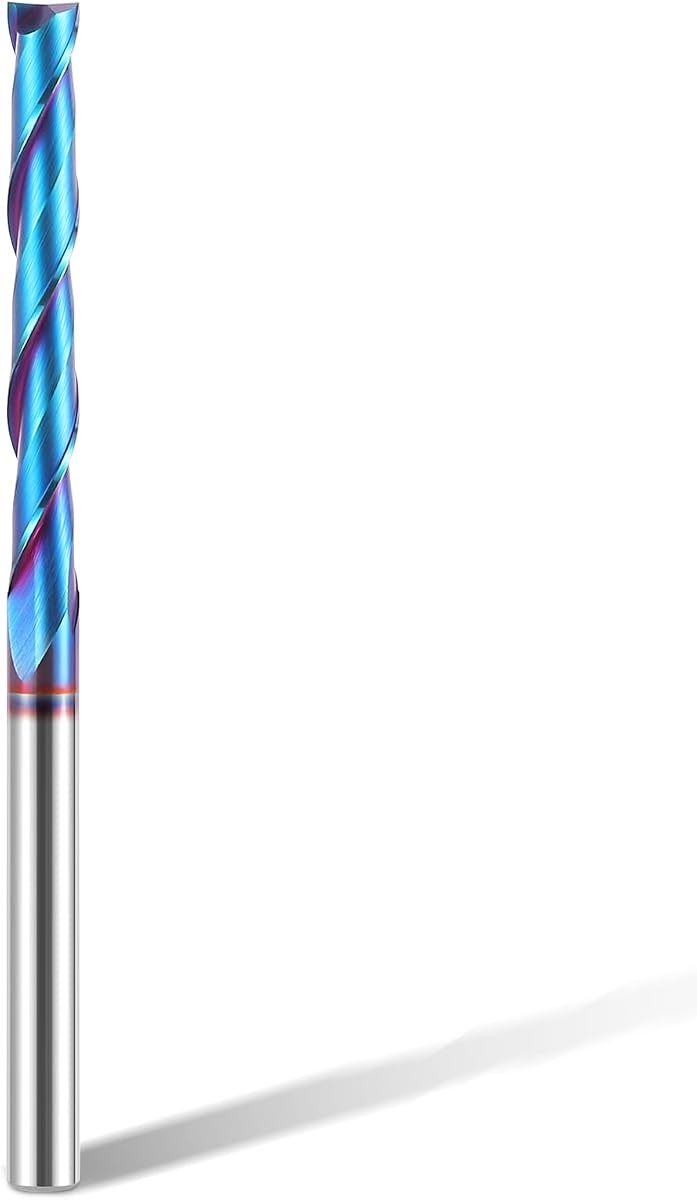
HQMaster's four-inch overall extra-long spiral reaches into deep mortises and CNC pockets where standard two-and-a-half-inch bits cannot go. Two-inch cut length and nano blue coating aim at carving and milling applications that need flute engagement deep inside the workpiece without plunging repeatedly from above.
Long bits amplify runout and deflection. Use collet cleanliness, reduced stick-out where possible, and conservative feeds. The 4.3 rating suggests mixed experiences—likely from users pushing reach beyond their machine stiffness. Check the live Amazon listing for current specs and compatibility before you buy.
Shorten toolpath stick-out in CAM when possible—even with long bits.
Inspect collet for wear; long bits amplify any runout.
Nano coating benefits show in abrasive MDF cycles more than single-pass oak.
Keep a standard-length spiral for everyday work; deploy extra-long for special reach only.
Best on rigid CNC frames; handheld use needs exceptional control.
Peck deep pockets instead of full-depth plunges when possible.
Lower RPM for large cut width; raise only when chips stay intact.
Test in scrap matching your project species before production runs.
We may earn a commission at no additional cost to you.
Whiteside's RFT2100 merges spiral shearing action with double-bearing flush-trim geometry—template routing with the cleaner grain slice spirals provide versus straight-flute trim bits. At 4.5 stars, it is the specialist pick when you follow patterns in hardwood, laminate, and solid-surface materials on a router table.
Mount the template above the work per Whiteside guidance, keep bearings spinning freely, and let the upcut helix slice rather than hammer. This is not your everyday slotting bit—it is the flush-trim spiral you reach for when template fidelity defines the project.
Check bearing smoothness before template runs; replace if gritty.
Template thickness must match bit bearing path; off-thickness templates lie.
Spiral flush-trim reduces tear-out on cross-grain template segments versus straight flutes.
Double-bearing design spreads side load—still avoid excessive lateral pressure.
Template on top, pattern following bearing path, steady feed against rotation.
Spiral shear shines on hardwood cross-grain segments.
Lower RPM for large cut width; raise only when chips stay intact.
Test in scrap matching your project species before production runs.
We may earn a commission at no additional cost to you.

ZahyoX's two-pack upcut spirals with NACO nano coating offer backup-bit value for hobby CNC and handheld routing at a twin-pack price point. Specs mirror many rivals—1/4-inch shank, one-inch cut length, two-flute upcut—but the listing carries no Amazon rating yet at our publish check.
Treat the twin pack as stocking spares or A/B testing coated imports rather than a Whiteside replacement. Verify runout on both bits before trusting a long production run; backup bits earn their keep when one snaps mid-project. Check the live Amazon listing for current specs and compatibility before you buy.
Run both bits in scrap to compare runout before assigning primary and backup roles.
NACO coating claims heat resistance—still use dust collection and appropriate RPM.
Without rating history, read recent Q&A on the live listing for QC notes.
Twin pack suits stocking two identical paths for nested CNC jobs with backup ready.
Assign primary and backup or use matched pairs on multi-head setups if applicable.
Verify both bits before relying on them for paid client work.
Lower RPM for large cut width; raise only when chips stay intact.
Test in scrap matching your project species before production runs.
We may earn a commission at no additional cost to you.

Spiral router bits are defined by helix direction, cut length, coating, and whether you route handheld, on a table, or on CNC. Match the bit to the face you need clean and the depth you must reach.
Upcut spirals evacuate chips aggressively and clean slot bottoms—great for dados and grooves. Downcut spirals protect the top surface. Compression bits combine both for sheet goods with two good faces.
Most shops stock upcut generalists first, add downcut for visible-top work, then compression for CNC plywood nests.
One-inch cut length covers most handheld and table grooves. Longer cut lengths reach deeper mortises but increase deflection. Extra-long bits demand rigid setups and lighter chipload.
Buy length for your deepest common cut plus minimal stick-out—not maximum possible reach.
Every bit in this guide is solid carbide—appropriate for woodworking routers and CNC spindles. Carbide holds edge longer in MDF and hardwood when feeds are correct.
Replace carbide when finish degrades; resharpening is specialist work for spirals.
TAC, nano, and NACO coatings aim to reduce heat and extend life—benefits show most in abrasive MDF and long CNC runs. Uncoated premium grinds like Whiteside still excel with proper feeds.
Test coated imports in your material before assuming 2.5× life marketing applies to your workflow.
1/4-inch shank spirals fit most trim routers and many CNC spindles with ER11 collets. Verify collet quality and runout before blaming the bit for wavy walls.
CNC users should set chipload-aware feeds; handheld users focus on steady feed and plunge control.
Spiral flush-trim bits like Whiteside RFT2100 optimize template work—not general slotting. Keep a separate upcut for dados.
Inspect bearings regularly; template work loads bearings sideward.
Whiteside leads for proven grind quality. SpeTool and HEME offer coated value tiers. Import SHARPRO/ZahyoX suit experimentation and backup stocking.
Standardize on one proven upcut for daily work, experiment with budget coated twins on low-risk jobs.
Seat the shank fully in a clean collet without bottoming the cutter incorrectly. Set RPM based on bit diameter and material—small spirals and hardwoods generally need higher RPM with light chipload, but deep cuts need slower speeds and multiple passes.
For upcut spirals, expect chips to exit toward the router. Use dust collection and keep hands clear of the path. On handheld work, feed against bit rotation on edge cuts to maintain control.
Downcut spirals require attention to chip packing in deep blind cuts—peck or vacuum frequently. Support thin work near the bit exit to limit blow-out on the bottom face.
Compression bits need depth set to engage both flute zones per design intent. On CNC, program ramp entries instead of plunging straight into solid material when possible.
Template flush-trim spirals demand secure pattern attachment and smooth bearing rotation. Do not lateral-load the bit; follow the template with steady feed.
After routing, brush flutes clean, inspect for chips or damage, and store bits protected. Replace when burn marks return despite correct feeds—dull spirals overheat fast.
Whiteside RU2100 upcut spiral is our Editor's Choice for dados, grooves, and general slotting with excellent chip clearance and a 4.8 rating.
Use downcut when the top surface of the workpiece is the show face during the cut—melamine shelf dados and visible-top inlay pockets are common examples.
Compression spirals combine upcut and downcut flutes to reduce tear-out on both top and bottom faces—ideal for plywood and laminated sheet parts on CNC.
Yes—all listings here specify 1/4-inch shank compatibility with handheld routers and many CNC spindles. Control stick-out and feed for best finish.
Coatings can extend life in abrasive MDF and long CNC runs. Premium uncoated grinds still excel—test in your material before assuming marketing multiples apply.
Spiral shearing action often yields cleaner walls and better chip evacuation in grooves and dados, especially in plywood and hardwood.
Template routing—following a pattern with bearing guidance while spiral geometry reduces tear-out versus straight flush-trim bits.
Clean collets, minimal stick-out, appropriate chipload, and avoiding sideways loads during template work prevent most snaps.
Start with Whiteside RU2100 for everyday upcut slotting, add SpeTool compression for sheet goods, and keep Whiteside RFT2100 for template flush-trim when patterns define accuracy.
Downcut and long-reach spirals are specialists—buy them when the job proves you need them, not before you outgrow a good upcut. Coated imports like HEME offer value for hobby CNC; validate in your material.
Use the comparison table to match cut direction and length to your workflow, then confirm shank and collet compatibility on the live listing before the first plunge.