The JessEm Mast-R-Lift II is a router lift—an above-table height mechanism you mount in a router table—not a handheld woodworking router. If you came here looking for a plunge motor, pause: this review is about precision bit height, cam locking, and getting a fixed-base router into a serious table setup. We cover fitment, insert rings, daily workflow, and where a lift earns its keep versus a bare plate.
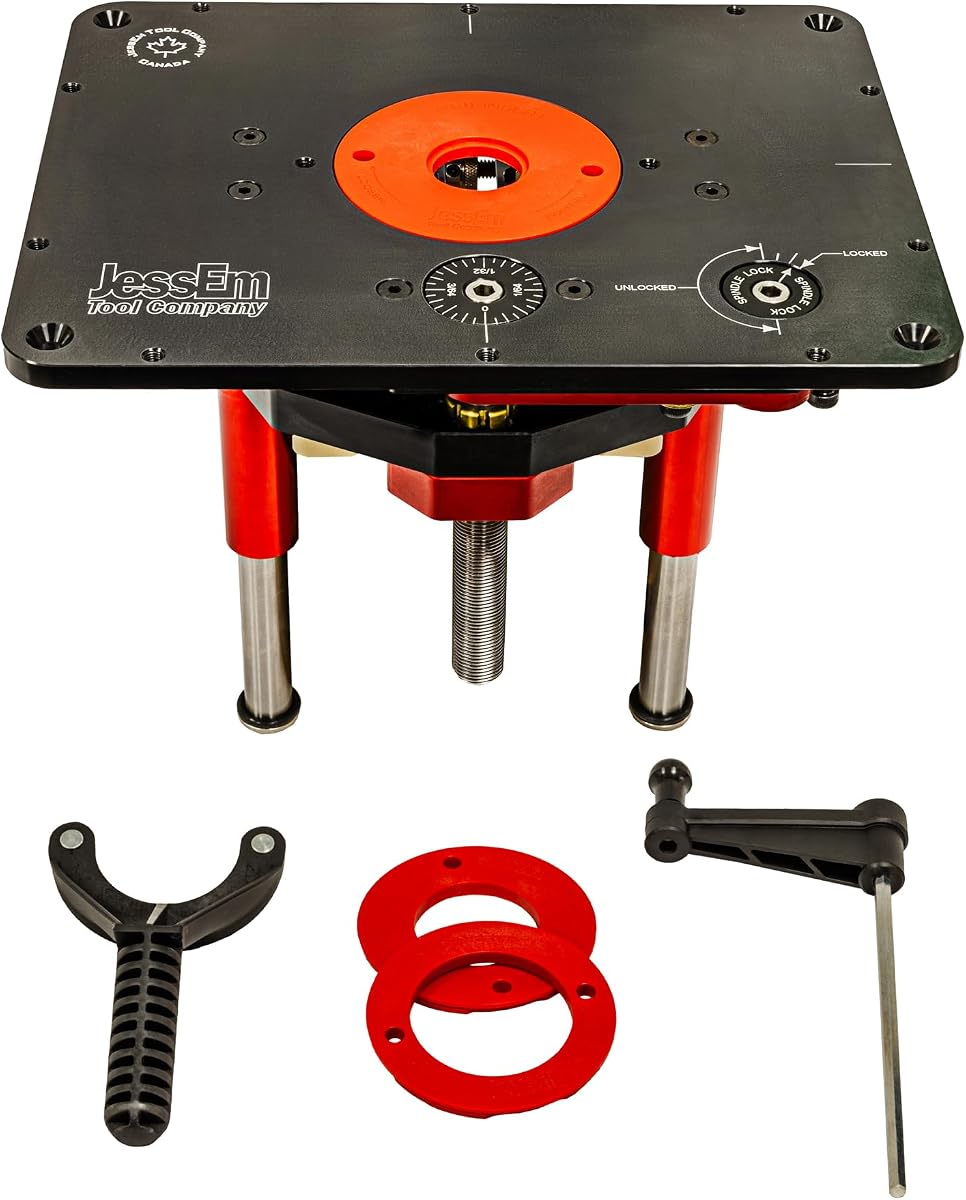
Call the Mast-R-Lift II what it is: a precision router lift. JessEm machines a 3/8-inch solid aluminum top plate, hard-anodized for wear resistance, and pairs it with a carriage that raises and lowers a fixed-base router motor from above the table. The point of that architecture is workflow. Instead of crawling under a cabinet, wrestling a collet nut in the dark, and re-zeroing depth after every bit swap, you crank the motor up, change the bit, drop back to height, and lock. Shops that run panels, door edges, and cope-and-stick joinery feel that difference every afternoon.
The exclusive cam locking system and double-sealed bearing construction are the mechanical story. Height adjustment should feel smooth rather than sticky, and the lock should keep the bit from creeping under load. That matters when you are raising a large raised-panel bit a few thousandths at a time or sneaking up on a flush-trim pass. Soft plastic plates and bargain lifts often flex or chatter once a heavy bit starts spinning; JessEm’s plate mass and pressed construction are aimed at that exact failure mode.
In the box you typically get the Mast-R-Lift II, three insert rings (1-3/8", 2", and 2-1/2"), an insert wrench, a crank handle, stainless set screws with Nylok patch, and mounting screws. Those rings close the gap around the bit so the workpiece does not tip into a giant hole—basic tablecraft that still gets ignored on cheaper plates. Confirm your router table’s opening and leveling system before you cut the opening or drop the plate into an existing recess. Universal claims mean most fixed-base routers fit, not that every exotic motor or odd base pattern will drop in without checking JessEm’s compatibility chart.
Who actually needs a lift this serious? Anyone building a dedicated router table station for production-style work: cabinetry, molding, repeated joinery setups. If you only round over a shelf twice a year with a palm router, this is the wrong category of purchase. If your table already hosts a good fixed-base motor and you are tired of under-table bit changes, the Mast-R-Lift II is the upgrade path that changes how you sequence a project. Pair it with a stout fence, dust collection, and a habit of locking the carriage before every cut.
Limitations stay honest. A lift is not a substitute for a square fence, a flat tabletop, or a sharp bit. Above-table changes still demand correct collet seating and wrench technique. Heavy bits need appropriate speed and feed; the lift holds height—it does not rewrite physics. Installation quality matters as much as brand: a twisted recess or uneven leveling screws will make a premium plate look mediocre. Treat fitment, leveling, and motor mounting as part of the product experience, not an afterthought.
Compared with basic router plates that only hang a motor, a true lift like the Mast-R-Lift II buys micro-adjustability and above-table convenience. Compared with JessEm’s own heavier or specialty lifts, this universal model is the shop-standard pick for most fixed-base setups. Read current motor compatibility before you buy, especially if you run a large HP motor or an uncommon base. Once installed and dialed, this is furniture for the table—not a gadget—and it behaves like it.
Bottom line: buy the Mast-R-Lift II when you are ready to treat the router table as a primary machine. Skip it when you still need a handheld router for the work itself. The lift elevates a motor you already trust; it does not replace that motor, and it will not turn a floppy table into a precision instrument without the rest of the setup catching up.
Who it's for
Cabinetmakers, furniture builders, and serious hobbyists running a dedicated router table who want above-table bit changes and repeatable height control with a fixed-base router motor.
Who should skip it
Skip this if you need a handheld or plunge router for freehand work, template guiding, or jobsite trimming. Also skip if your table is temporary plywood chaos—stabilize the table first, then invest in a lift.
Installation & compatibility
Verify your router’s base pattern against JessEm’s universal fit list, measure the table opening, and plan leveling screws carefully. Take time on the first install; a square, coplanar plate matters more than rushing to cut a raised panel the same afternoon.
Daily table workflow
Crank up for bit changes, seat the bit fully, lock the collet, return to height, engage the cam lock, and confirm with a test cut on scrap. Keep insert rings matched to bit diameter so stock stays supported at the cut.
- True above-table bit changes save real shop time
- Cam lock holds height without constant babysitting
- Solid aluminum plate feels like furniture-grade hardware
- Insert ring set covers common bit diameters
- Universal fit for most popular fixed-base routers
- Does nothing without a router table and compatible motor
- Not a handheld router—wrong buy if you need a freehand tool
- Installation and leveling still take careful setup